From pink tickets to Python: Toby Baker on 40 years in FX
T Rowe Price’s departing FX head reflects on the pain points and keys to success for a modern buy-side trading desk
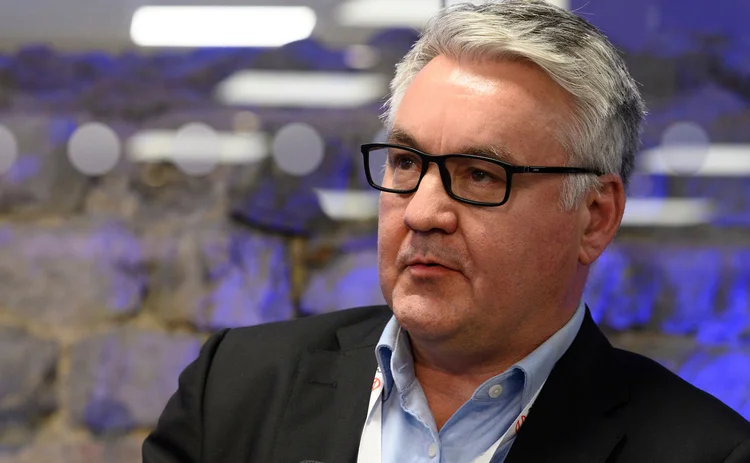

How would you imagine your last fortnight before retirement? An orderly handover, perhaps, with time to put your feet up. Unfortunately for Toby Baker, head of foreign exchange trading at T Rowe Price, US president Donald Trump had other plans.
Baker retires at the end of March after 25 years on T Rowe’s FX desk and four decades in the industry – stepping away at one of the more chaotic moments in global markets. But during his time on the buy side he has traded through them all: the global financial crisis, the eurozone sovereign debt crisis, the Swiss National Bank’s de-peg in 2015, the Covid pandemic and Russia’s invasion of Ukraine.
“The market’s always going to be up or down, but from a trading perspective it does feel the right time to be leaving,” Baker says. “It’s also good to be leaving in a busy market knowing the team here is going to take what we’ve been working on forwards.”
What also reassures him is that he is leaving FX at a point where, as he puts it, “it’s the most efficient it’s ever been” – certainly a far cry from the days when traders had to write buy on blue tickets and sell on pink tickets.
“When I started, we had to deal with hundreds of pink and blue tickets that were manually filled in by PMs, traded and then manually read over all the account splits. Incredibly inefficient,” he says. “The trading was fine, but it was the booking of the tickets that needed to change.”
Hedge funds can generally trade on anything with anyone – that’s ultimately where I’d love to see the real money buy side get to

The arrival of electronic trading platforms from 2001 onwards was, he says, “a defining moment” for making the FX market so much more efficient. That shift towards automation has fuelled much of Baker’s own work at T Rowe.
At an FX Markets Europe event in 2024, he described FX options workflows as being “like it’s written on the back of a cigarette packet”. To address this, the asset manager partnered with execution management system vendor Portware in 2025 to trade FX options on Digital Vega’s multi-dealer platform, a move Baker said at the time would reduce operational risk and improve performance.
It is because of this move towards automation that Baker feels he is leaving the industry in a position of strength – one where market structure has held up even under extreme stress.
“The fact that we’ve gone through immense geopolitical risk where, historically, it would have been enough to cause severe kinks in the market structure – the fact that we haven’t had that shows both buy side and sell side are able to ride out these extreme volatility moves,” he says.
Evolving skillsets
Against this backdrop, Baker notes that the role of a buy-side trader in 2026 looks very different from when he began his career. Coding skills often take precedence over voice trading, he says, but knowing Python does not make you a good trader – what matters is thinking strategically about execution.
That could mean building automated tools to make day-to-day trading more efficient, or knowing when to execute a risk transfer over voice rather than with an algo.
Transaction cost analysis (TCA) tools have made the biggest difference to how buy-side desks execute, he says. Post-trade TCA has enabled these desks not only to scrutinise the prices they receive from dealers, but also to work with portfolio managers to improve execution processes.
“Post-trade TCA has given us the ability to really analyse how we trade and to use statistics to get a better outcome. Going into the trades, there should be no more surprises,” he says.
Choosing long-term impact over quick wins isn’t easy, but it’s the only way to build something that lasts for your clients and for your own legacy
Decision-making on the desk is now more data-driven than ever, Baker says. His team has the information to know when to ask a single dealer for a direct price rather than working 10 to 15 banks in competition, which reduces information leakage and improves efficiency. That said, he notes there is still a place for competitive requests-for-quotes (RFQs).
“There is no right way or wrong way of trading, just different outcomes. And if you are statistically getting worse outcomes, then you need to change the way you are trading,” he says.
Artificial intelligence could push this further. Baker sees a future where a trader could ask an agentic AI model which bank algo to use or which dealers to approach for a risk transfer price.
“That is where it is going to go, but you still need someone to sanity-check it,” he says.
Another skill he sees becoming more important for the buy side is trade idea generation. In the past, this was typically the preserve of portfolio managers and strategists, but Baker argues that traders who interact with banks and platforms daily are in an ideal position to come up with their own ideas.
“The traders are the closest to the Street, and if the Street gives us good ideas, hopefully we can put some of those in front of the decision-makers to put them into action,” he says.
Frustrations
What has not changed – much to Baker’s frustration – is the credit infrastructure that constrains how asset managers access the market. Unlike hedge funds, which use a foreign exchange prime broker (FXPB) to trade with the wider market, asset managers face restrictions on which counterparties they can deal with, including non-bank market-makers, and capacity limits when dealing with a single bank. It also requires negotiations of credit support annex documentation and onboarding with individual dealers, introducing significant friction when wanting to use a new bank.
“A real pain point for the market, at least for the real money community, has been for us to deal with who we want,” Baker says.
“Hedge funds can generally trade on anything with anyone – that’s ultimately where I’d love to see the real money buy side get to. If we can find better solutions for credit intermediation, then I think it will help the industry a lot.”
Baker also emphasises the importance of the relationships his team has built with its bank counterparties that have helped his team get through many of the market crises over the years.
He recalls Russia’s invasion of Ukraine in 2022 as a key moment when T Rowe leaned on the trusted relationships it had established with its dealers to manage its risk.
“We, for years, have tried to foster good relationships, which means in volatile times the pricing should remain relatively stable. They know we’re not going to run them over, and likewise, if they run us over, then conversations will be had,” he explains.
Baker says this “culture of trust” he has cultivated over the years gives him confidence that the desk will carry on effectively once he departs. He also notes that sell-side knowledge of the real money community is “as good as it’s ever been”, in part because many senior salespeople at the banks are former junior traders on the buy side.
But he acknowledges that cost pressures on the sell side means coverage for real money clients is not what it was.
“There’s a lot less sales people covering more clients, so it depends how you’re rated or tiered by those sales people. I would say that T Rowe is top-tiered, so I feel like we get really good coverage. If you are not, then unfortunately, you’re probably more e-priced rather than bank-priced, and that can make a difference,” he says.
Once Baker hangs up his gloves at the end of March, his immediate plans include travelling and attending the Fifa World Cup this summer with his son. He says he will stay involved in the FX industry in some capacity and will pop up at various conferences.
In the meantime, he leaves behind some advice for the next generation of traders. The first is to listen to those around you and find a mentor – someone you can ask “the dumb questions”, as he puts it. This is the only way to effectively engage and learn something, he says.
The second is to build with a three-year roadmap in mind, whether that is a new tool on the desk or a counterparty relationship.
“Choosing long-term impact over quick wins isn’t easy, but it’s the only way to build something that lasts for your clients and for your own legacy,” he says.
Editing by Lukas Becker
Only users who have a paid subscription or are part of a corporate subscription are able to print or copy content.
To access these options, along with all other subscription benefits, please contact info@fx-markets.com or view our subscription options here: https://subscriptions.fx-markets.com
You are currently unable to print this content. Please contact info@fx-markets.com to find out more.
You are currently unable to copy this content. Please contact info@fx-markets.com to find out more.
Copyright Infopro Digital Limited. All rights reserved.
As outlined in our terms and conditions, https://www.infopro-digital.com/terms-and-conditions/subscriptions/ (point 2.4), printing is limited to a single copy.
If you would like to purchase additional rights please email info@fx-markets.com
Copyright Infopro Digital Limited. All rights reserved.
You may share this content using our article tools. As outlined in our terms and conditions, https://www.infopro-digital.com/terms-and-conditions/subscriptions/ (clause 2.4), an Authorised User may only make one copy of the materials for their own personal use. You must also comply with the restrictions in clause 2.5.
If you would like to purchase additional rights please email info@fx-markets.com
More on Trading
US fund managers reshuffle dealer books amid new trading highs
Mutual funds, ETFs hit record FX forwards positions but retreat from options; insurers rotate counterparties

Hedge funds crowd into bullish Brazilian real trades
Funds snap up FX options betting on stronger real after a Bolsonaro win

Fund giants turbocharge Wells Fargo’s FX forwards book
Counterparty Radar: US bank jumps from 12th to second in Q2 2026 dealer rankings as Pimco and Vanguard ramp up trading

Jackpot for JGB asset swaps after hedging rush
Multi-leg trade turned profitable as corporate cross-currency hedging flows helped push yen swap rates above JGB yields

US rates surge sparks new wave of FX net investment hedging
Corporates pile into currency hedges to protect value of foreign assets and capture positive carry

Emerging markets options trading outpaces G10
Growth in EM options volumes between dealers and clients are nearly double that of G10 pairs

BNP Paribas outlines path for FICC algos, SDP and AI projects
After taking on new Cortex and AI roles, BNPP's Razaq sets out the bank's expansion plans and new tech projects
Dollar reversal could scupper EM carry boom, dealers warn
Surprise rate hike or a USD rally may force unwinds in popular emerging markets carry trades