Liquidity issues may prevent RMB's entry to SDR
Say conference panellists and Allen & Overy report

Inadequate liquidity in Chinese renminbi derivatives is putting participants off hedging the currency and this is one of the biggest obstacles to the country joining the International Monetary Fund's special drawing rights basket (SDR), according to panellists at a Securities Industry and Financial Markets Association (Sifma) conference in New York.
Concerns over liquidity were highlighted in a report from law firm Allen & Overy. Two-thirds of the 150 respondents – all senior executives at corporates with exposure to the Chinese unit – agreed "a lack of liquidity is an important or very important obstacle to greater usage of the renminbi in cross-border transactions".
Speaking at the Sifma event on June 24, entitled The Globalization of China Markets, Wei Wang, managing director and head of fixed-income research at Bank of China International (BoCI), labelled China's chances of gaining SDR status as "60/40" and said the country has been trying to create more liquidity channels quickly in order to achieve it.
"One of the key aspects for RMB to join the SDR basket is liquidity, and liquidity inside China is an ocean, but that ocean has just not opened up yet. Now that China is trying to create more channels, that is what China is trying to do – accelerate the openness of cross-border channels," said Wang.
Failing to change
China is now in fifth place in terms of global payment volumes, leaping from the position of 20th it held only four years ago, with the speed of change catching some corporates unawares.
Now that China is trying to create more channels, that is what China is trying to do – accelerate the openness of cross-border channels
Allen & Overy's report highlights how some companies have failed to adjust quickly enough to mirror the renminbi's rise through the ranks, while inadequate liquidity in FX derivatives has not been conducive to hedging.
"The biggest obstacle to greater usage of the renminbi by businesses internationally lies in the slender grasp [that] non-Chinese companies have on how to conduct such transactions. This varies by region: it is cited as a very important or important obstacle by 84% of US respondents and 82% in the Asia-Pacific region, but just 66% of European respondents, reflecting a possible edge in Europe in building RMB competence," the report said.
"Company treasurers sometimes complain about the lack of RMB-denominated hedging products in the market: insufficient liquidity in offshore RMB-hedging instruments, such as RMB forwards, forex options and swaps, was cited by 36% as a very important or important obstacle to the greater usage of the currency," the report continued.
IMF decision
Turning their attention to the IMF's impending decision in October, participants were split on whether the renminbi would be included in the SDR basket. However, although the Fund only makes this kind of decision every five years, it has given itself the option to review the currency's status again in 2016.
"Once you start tugging on that thread of SDR participation, you find it really does open up very large windows on flows. China has had net capital outflows over the past nine months already, so to some extent they have already created the source of pressure here that forces a very rapid effort to address the risks," said Daniel Rosen, founding partner and China practice leader at consultancy firm Rhodium Group.
"China does not have to feel rushed into doing something prematurely without thinking through the factors, such as it will change the SDR borrowing cost for any country that has an IMF programme, because the RMB benchmark rates are higher right now than any others in the basket. It will push up borrowing costs for Ukraine or anyone else that needs an IMF programme – modestly, but enough to be a non-trivial consideration," he continued.
Douglas Elliott, a fellow in economic studies at the Brookings Institution in Washington, DC, reckons it's "50/50" whether the currency is included in the SDR basket.
"We have our own national pride on the line. Every time the role of the dollar diminishes, you see a political backlash where people point fingers, so we have the same kind of political pressures to want this to go slowly. We also know it's important to China, so we don't want to piss them off," he said.
Only users who have a paid subscription or are part of a corporate subscription are able to print or copy content.
To access these options, along with all other subscription benefits, please contact info@fx-markets.com or view our subscription options here: https://subscriptions.fx-markets.com
You are currently unable to print this content. Please contact info@fx-markets.com to find out more.
You are currently unable to copy this content. Please contact info@fx-markets.com to find out more.
Copyright Infopro Digital Limited. All rights reserved.
As outlined in our terms and conditions, https://www.infopro-digital.com/terms-and-conditions/subscriptions/ (point 2.4), printing is limited to a single copy.
If you would like to purchase additional rights please email info@fx-markets.com
Copyright Infopro Digital Limited. All rights reserved.
You may share this content using our article tools. As outlined in our terms and conditions, https://www.infopro-digital.com/terms-and-conditions/subscriptions/ (clause 2.4), an Authorised User may only make one copy of the materials for their own personal use. You must also comply with the restrictions in clause 2.5.
If you would like to purchase additional rights please email info@fx-markets.com
More on Foreign Exchange
Average reported daily UK FX turnover hits record high
Daily turnover of $2,881bn in October 2019, up 2% from previous high of $2,821bn in April

PBoC injects 1.2 trillion yuan as markets plunge
Chinese central bank eases to support economy as coronavirus spreads; Q1 GDP growth could drop to 4%
Spot volumes on platforms resumed downward trend in 2019
But an uptick was seen in FX swaps and forwards submitted for settlement

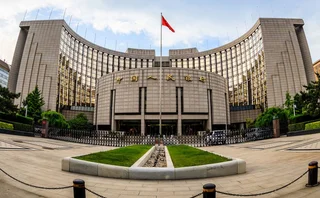
PBoC extends market closure as coronavirus spreads rapidly
Chinese central bank extends interbank markets closure and vows to maintain ample liquidity